
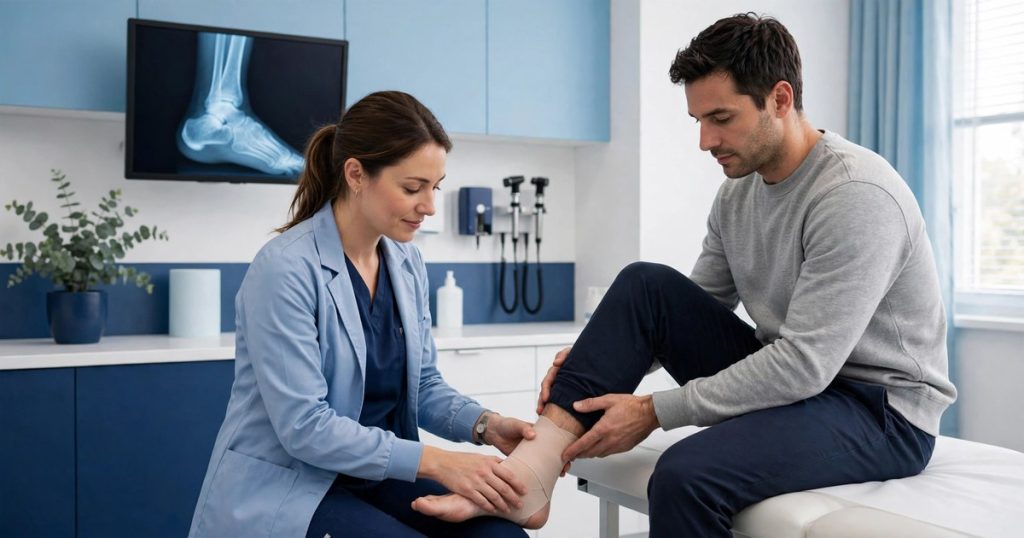
It is the question everyone asks while hopping on one foot: is it a sprain, or did I break something? The honest answer is that from the outside, even for medical professionals, the two can look nearly identical. Both swell, both bruise, both hurt. Here are the signs that point each way, what to do in the first hour, and the test that actually settles it.
Why you often cannot tell
A sprain is damage to the ligaments that hold a joint together. A fracture is a crack or break in the bone itself. A bad sprain and a small fracture produce the same swelling, the same bruising, and sometimes the same amount of pain, because the injured tissues sit side by side. Pain level alone is a poor guide: some fractures ache mildly, and some sprains are excruciating. That is why providers rely on the pattern of signs below, plus imaging, rather than on how it feels.
Signs that point toward a fracture
- You cannot bear weight. Being unable to take four steps, both right after the injury and later, is one of the strongest pointers.
- The pain is on the bone itself. Pressing gently along the bone produces a sharp, specific tender spot, rather than a general ache around the joint.
- Something looks wrong. A bend, angle, or shortening that was not there before.
- You heard or felt something at the moment of injury. A snap, crack, or grinding sensation.
- Numbness or tingling beyond the injury, or fingers and toes that look pale or feel cold.
- Swelling and bruising that came on fast, within minutes rather than hours.
Signs that point toward a sprain
- The pain centres on the soft tissue around the joint rather than on a specific point of bone.
- You can bear some weight, even if it hurts and you limp.
- The joint feels unstable or wobbly rather than deformed.
- Swelling built up gradually over hours.
- You can move the joint a little, with pain, instead of movement being impossible.
None of these signs, alone or together, proves anything. They decide how urgently you should be seen and whether imaging is needed, which is exactly what an urgent care assessment is for.
First aid: RICE
- Rest. Stop using the injured joint. Continuing to play or work on it makes both sprains and fractures worse.
- Ice. Apply a cold pack through a cloth barrier for 15 to 20 minutes at a time to limit swelling.
- Compression. A snug elastic bandage helps with swelling. If fingers or toes tingle, turn pale, or feel colder, it is too tight.
- Elevation. Raise the limb above heart level when you can.
If a bone might be broken, keep the limb still and supported in the position you find it rather than trying to straighten it, and head in to be seen.
What an X-ray shows, and what it does not
An X-ray shows bone clearly: most fractures, their position, and whether the bone has shifted. It does not show ligaments, tendons, or cartilage, so a sprain will never appear on one. Two limits are worth knowing. Hairline fractures can be subtle enough to hide on a first X-ray and show up on a repeat image a week or so later, which is why an injury that stays painful gets rechecked. And a normal X-ray does not mean nothing is wrong, it means the bones are intact, and a serious sprain can still need proper treatment and weeks to heal. C&C Express has X-ray diagnostics on site, so the assessment and the imaging happen in one visit.
When it is an ER matter
- Bone visible through the skin, or a wound over a likely fracture
- An obvious deformity, such as a limb bent at an angle it should not bend
- A limb that is pale, blue, or cold below the injury, or has no pulse
- An injury from a high impact event, such as a car crash or a fall from height
- A suspected fracture of the hip, pelvis, spine, or skull
Our guide to urgent care vs. the ER explains the dividing line, and if the skin is broken as well as the bone beneath, our stitches guide covers the wound side of it.
Recovery, in general
A mild sprain settles in days to a couple of weeks with rest and gradual movement. A significant sprain can take as long as a fracture to heal fully, and rushing back is how ankles end up permanently loose. A fracture that has not shifted is usually immobilised in a splint or cast for several weeks, with follow up imaging to confirm healing. Either way, the recovery clock starts when the injury is properly assessed, not when it happened.
Frequently asked questions
Can I walk on it if it is broken?
Yes, sometimes, and this is the myth that catches people out. Some fractures, including common ankle and foot fractures, can bear weight, painfully. Being able to walk does not rule out a break. Being unable to bear weight is a warning sign, but the reverse is not a clearance.
Do I need an X-ray?
If any of the fracture signs above are present, yes. Providers use well established examination rules for ankles, feet, and knees to decide who needs imaging, and when the exam says image, the X-ray is quick and settles the biggest question on the spot.
Can urgent care handle a broken bone?
For most straightforward fractures, yes: assessment, on-site X-ray, pain control, and a splint to protect the bone, then a referral to an orthopedist for follow up and, where needed, a cast. Fractures that are displaced, open, or in high risk locations are stabilised and sent to hospital care. You can book a visit online or walk in.
What if it is broken, then what?
You leave with the injury protected, clear instructions on weight bearing and pain relief, and a follow up path with an orthopedist. Most simple fractures heal without surgery. The ones that need more are identified at this first visit, which is precisely why getting it assessed early matters.
This article is for general information only and is not medical advice. It does not replace diagnosis or treatment by a qualified healthcare provider. If you are experiencing a medical emergency, call 911 or go to the nearest emergency room. For non-emergency care, call C&C Express Urgent Care at 770-217-5479 or book a visit online.